
THOMAS HAUSER
Jake Paul vs. Anthony Joshua in Perspective
THE SCORECARD / Jake Paul vs. Anthony Joshua in Perspective
Larry Holmes is on the short list of greatest heavyweights of all time. He fought with honor and he fought the best. Years ago, I asked Holmes, “Suppose you could travel back in a time machine and fight any heavyweight champion in history. Who would you want to fight?”
“If the money is the same,” Larry answered, “tell me which one is the worst fighter, and that’s the guy I want to fight.”
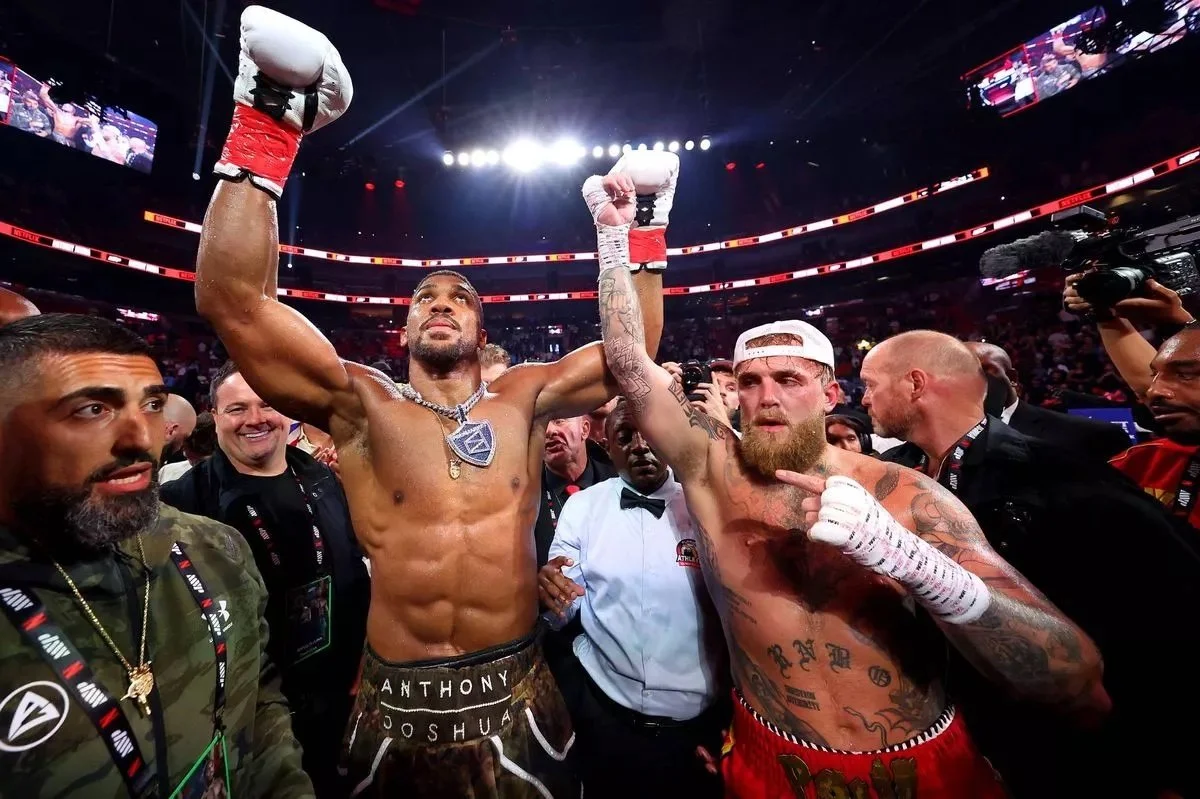
On December 19, Anthony Joshua took a page from Holmes’s playbook and knocked out Jake Paul at the Kaseya Center in Miami. The fight was widely ridiculed as preposterous, nonsensical, absurd, cynical, and demeaning to boxing. It also streamed worldwide on Netflix and was extremely profitable for those involved.
Joshua is a world-class heavyweight. He fell short of the greatness that he teased in defeating Wladimir Klitschko before 90,000 screaming fans at Wembley Stadium eight years ago. But he’s an elite fighter with a big punch.
Paul is a social-media personality who has parlayed his celebrity-status into an extraordinarily remunerative career as a club fighter. Prior to December 19, he’d scored twelve victories against a series over overmatched novices, a badly-faded Julio Cesar Chavez Jr, and 58-year-old Mike Tyson. The one time that Jake fought an active professional boxer, he was outpointed by a mediocre Tommy Fury.
Despite the fact that he’s a natural cruiserweight, Paul was scheduled to fight WBA 135-pound champion Gervonta Davis in Miami on November 14. Then allegations of repeated physical abuse of women by Davis led to the fight being cancelled and the talk turned to Jake fighting Joshua.
“Be careful what you wish for,” Eddie Hearn (AJ’s promoter) warned Paul when the idea was first floated. “This ain’t a game. This ain’t a YouTube video. This isn’t algorithms. This is physically dangerous.”
But Hearn left the door open, telling the media, “Look, I can’t necessarily justify it to you. I’ve never called for or told people we’re targeting this. It’s a mismatch in my opinion. It’s dangerous in my opinion. You’re in there with one of the biggest punchers of all time and it isn’t a game. [But] AJ understands the commercial world and will look at this and see that it’s huge. It would be right up there with his biggest purses ever.”
Thus it was that Jake Paul went from a scheduled fight against a 135-pound beltholder to a fight against 250-pound Anthony Joshua.
Joshua vs. Paul (formally styled as Jake vs. Joshua) was scheduled for eight three-minute rounds with the fighters wearing standard ten-ounce gloves.
Mismatches are often rejected by credible state athletic commissions to protect the health and safety of fighters. Similarly, by way of analogy, no one suggests that a fighter with a bad MRI should be allowed to fight simply because he’d be getting a big purse.
Several state athletic commissions were sounded out about Paul fighting within their jurisdiction but turned the idea down. The Florida State Athletic Commission (which is particularly lenient and “promoter-friendly” when it comes to overseeing combat sports) allowed the fight to proceed.
Joshua is said to have wanted PED testing for the bout to be conducted by VADA, which is widely regarded as the gold standard for PED testing in boxing. VADA had already been retained to administer drug testing for the December 19 undercard title bout between Alycia Baumgardner and Leila Beaudoin. But MVP (Paul’s promotional company) arranged for PED testing for the main event to be conducted by USADA.
Joshua tried to put a positive spin on the festivities, saying, “This fight creates conversation, barbershop conversations, taxi conversations, airplane conversations. And that's what we want. The more people talking about the fight, regardless of what it is that they're talking about, it is a massive bonus. So I'm not worried about what people think about the integrity side. I'm more worried about whether they are talking. And they're definitely talking. It’s massive. It’s colossal. It’s making big news.”
Meanwhile, Hearn pledged that the fight wouldn’t be scripted, stating, “We’d be investigated by the FBI if it was. It would be illegal. This is a professional contest and a sanctioned bout where people are betting on it. And do you think I would ever allow AJ to have a script with Jake? A script where we might lose or even hold him up and look bad? No way. This would be catastrophic for AJ and we’re not going to risk that.”
Joshua, at age 36, isn’t the fighter he once was. And Jake, to his credit, has evolved as a boxer to the point where he could beat many of the B-side opponents that one sees on small club-fight cards. Still, the argument against Joshua vs. Paul being a credible fight was substantial.
Jake is nowhere near Joshua’s level as a fighter. In a more reasoned world, he would at best have been someone who AJ fought in the second or third fight of his pro career when he was padding his record.
Joshua is bigger, faster, stronger, more powerful, and better skilled than Jake. The first jab he hit Jake with would likely be the hardest that Jake had been punched in his life. If they fought ten times – the thinking went – AJ would knock Jake out nine times. And the tenth time, he’d knock him out.
“It's got car crash written all over it,” Frank Warren said.
“Wouldn't it have been cool,” George Groves mused, “if Joshua just said, ‘Fuck that. I'm actually a professional. I'm going to fight someone who's worthy of sharing a ring with me.’”
“Every single boxing fan,” Carl Froch added,” knows that, if AJ goes in with Jake Paul and tries, the fight won’t last a minute. If he hits Jake Paul with that right hand, he might fucking snap his neck.”
It wasn’t a no-win situation for Joshua because he’d be making tens of millions of dollars – the easiest big money he’d ever make. Most fighters in his situation would have made the same decision to fight. But it was clear that a big-knockout victory would be met with “ho-hum; we expected that.” Winning but looking bad would tarnish AJ’s credibility. And a loss (which wasn’t going to happen) would destroy his legacy forever.
In sum; it was a foregone conclusion that Joshua would win. The open issue was how he’d do it. Every minute that Jake survived would be a victory for Jake. And the longer the fight went, the greater the embarrassment would be for AJ.
As the fight drew closer, Jake kept talking:
* “I'm a better boxer than AJ. He's got two left feet. He's stiff. If I was his coach, I'd put him in a dance class first before trying to box. It’s going to be mentally very difficult for him when I start to win rounds and he can’t hit me. It’s going to be very entertaining to watch and see him be frustrated.”
* “I don’t think he can knock me out because he’s not going to be able to line up his shots properly to be able to land the hard punch. I think it’s going to be a very tough fight for multiple rounds. But when I figure out his pacing, his style, his speed, his footwork, he’s going to get a little bit tired trying to chase me around and then I’m going to set up the shot. I see what it is and I think it will end in the fifth or sixth round.”
* “Let's fucking go, bro. This is what we're here to do is fuck each other up. I want his hardest punches. I want there to be no excuses when it's all said and done, and let's fucking kill each other.”
* “People say, ‘Oh, I respect Jake Paul for getting in there.’ No, respect me because I’m about to win. This is going to be the biggest upset in the history of sports.”
The fight was styled “Judgment Day,” although there was a school of thought that “Bad Judgment” would have been more appropriate.
Joshua weighed in at 243.4 pounds (his lightest weight in four years and safely under the 245-pound contract limit). Jake weighed in at 216.6.
Most professional boxing rings are 20-by-20-feet (400 square feet) inside the ropes. At Jake’s insistence, the ring for Joshua-Paul was 22-by-22-feet (484 square feet, 21% larger than the norm).
The hour of reckoning arrived.
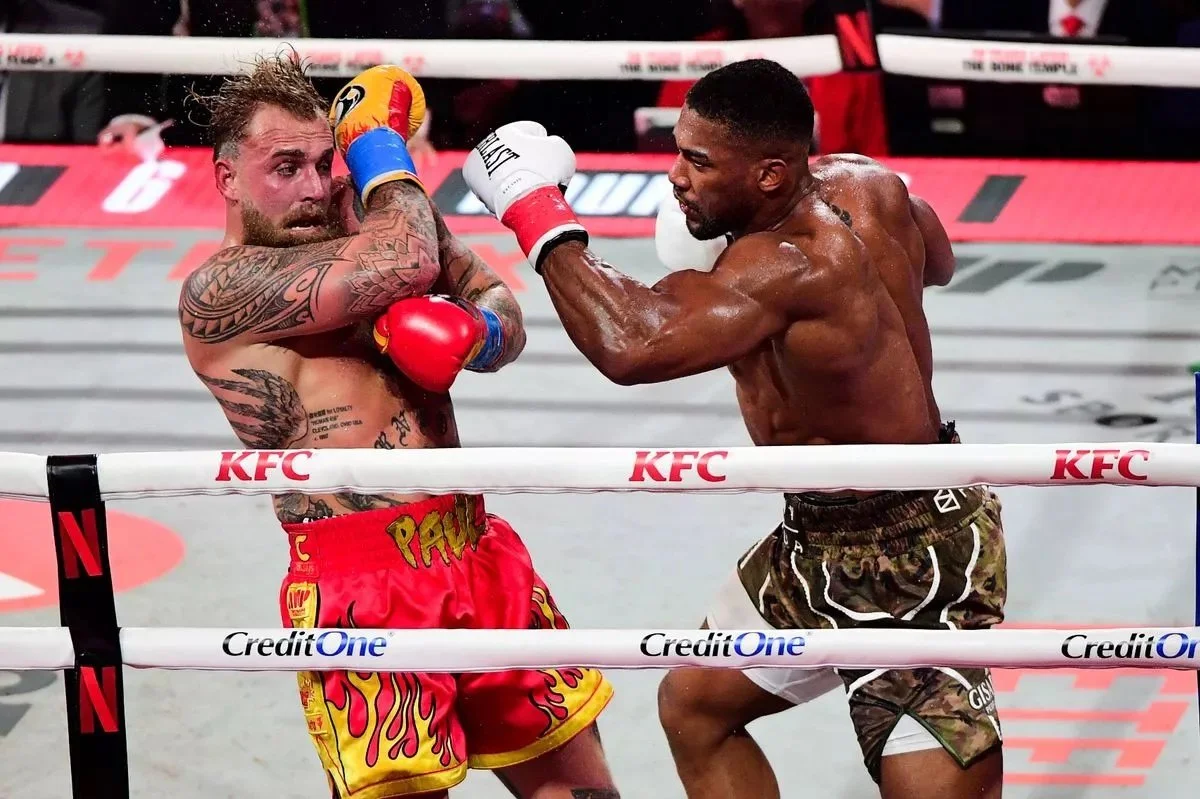
Rounds one through three saw Jake running around the perimeter of the ring (politely referred to as “lateral movement”) with virtually no punches landing either way. There were boos from the crowd. In a more credible competition, referee Christopher Young would have warned Jake for not fighting.
“I’m amazed at how much Anthony Joshua has missed,” blow-by-blow commentator Mauro Rinallo noted after round three.
So was I.
A fighter who’s stalking an overmatched opponent doesn’t simply follow him around the ring. He should do it behind a stiff jab (which Joshua has in his arsenal) and cut off the ring as follows.
The ring is a square. Imagine an opponent moving around the perimeter. The first thing a fighter who wants to cut off the ring should do is say to himself, “I own the center of the ring.”
Next, whichever side of the ring the opponent is on, the fighter should draw an imaginary line from one corner of the ring to the opposite corner and stand on that line with one shoulder pointed toward each corner. That cuts the ring in half.
Let’s assume that both boxers fight out of an orthodox stance (which Joshua and Paul do). If the opponent moves to his left, the fighter cutting off the ring should step forward with his left foot and slide to the right with his right foot. If the opponent moves to his right, the fighter cutting off the ring should still step forward with his left foot, take a short step with his right, and then slide to the left with his left foot. He’s now making the ring smaller and cutting down on his opponent’s avenues of escape. Then he repeats that process until he’s on top of his opponent. It’s a basic skill that Joshua has been taught. It’s not as though AJ has never had to cut off the ring before.
It’s more difficult to cut off the ring against some fighters than others. When Muhammad Ali was young, he was able to escape because he was incredibly fast on his feet. And if someone got inside on him, Ali knew how to tie the opponent up. Hector Camacho could escape because he was fast on his feet and a southpaw to boot. Also, if a fighter is being pursued, he can evade being pinned in by getting off first with a jab and forcing his pursuer to reset while he moves away again. As veteran trainer Don Turner once noted, “If Larry Holmes stuffed a jab in your face, all of a sudden you didn’t want to cut the ring off on him so much.”
But Jake Paul isn’t Muhammad Ali, Hector Camacho, or Larry Holmes.
Through four rounds against Jake Paul, Anthony Joshua landed only five jabs and a total of 17 punches. Five jabs in four rounds raised eyebrows. Indeed, CompuBox would credit Joshua with landing a meager 48 punches during the entire fight and Jake landed only sixteen.
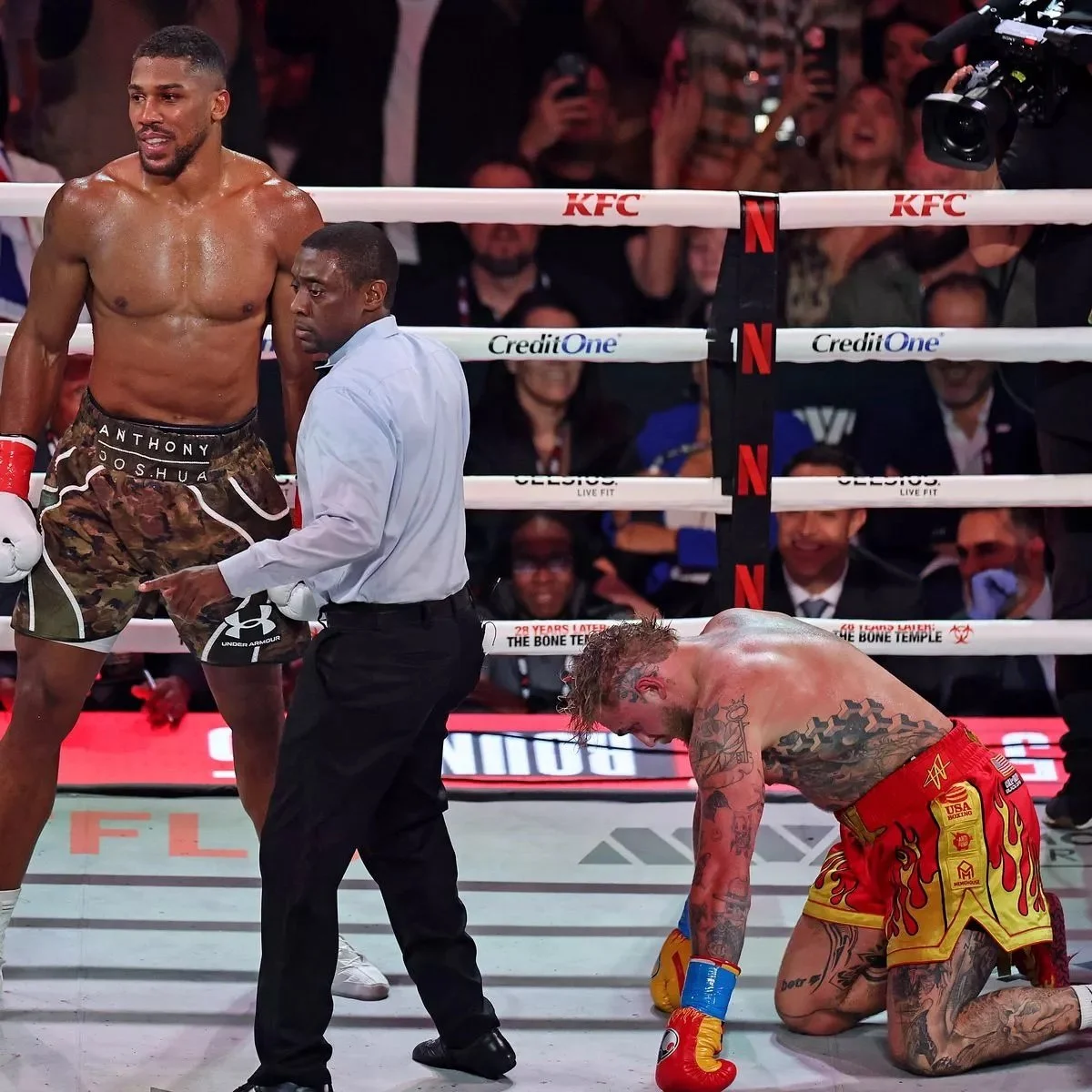
In round four, Jake tired noticeably, slowed down, and began dropping to the canvas when AJ got inside (in effect, calling a time out while the round was in progress). On one such occasion, he claimed a low blow (which replays failed to substantiate). But the referee gave him time to recover before warning the fighters, “Keep it clean. The fans didn't pay for this crap."
Also, at one point in round four, Paul dropped to the canvas as an evasive tactic and AJ threw several punches to the body when Jake was down. In theory, that could have resulted in a nightmarish disqualification.
By round five, Jake was exhausted and could no longer defend himself. Joshua dropped him twice in that stanza and twice more in round six. The finishing blow was a hellacious right hand that landed flush and shattered Jake’s jaw in two places.
Stopping the fight before that point would have led to Jake’s partisans complaining about a quick stoppage and upset Jake’s detractors who wanted to see Jake knocked unconscious. But the final punch was unnecessary. The referee’s job at that point was to protect the fighter, not appease the crowd.
YouTube hits are different from punches in a boxing ring.
“It was a bit messy,” Joshua acknowledged when the fight was done. “It wasn’t my best performance. What I could have done better is a lot of things. I think my coach expects more from me and I expect more for myself. I've got a lot of improvement that I need to do. So yeah, I'm not happy.”
I can’t help but think that, if someone had told AJ before the fight, “You’ll get a $20 million bonus if you knock Jake out in the first two rounds,” Joshua would have fought with more urgency in the early going and fans wouldn’t have seen round three.
One day after the fight, Jake posted a photo of himself in a hospital bed with the caption, “Surgery went well. thanks for all the love and support. 2 titanium plates on each side. Some teeth removed. Have to only have liquids for 7 days or so.”
The broken jaw gave those who wanted to see Jake obliterated their pound of flesh.
One might also give Jake some credit. Yes, he fought to survive, not win. But when he got knocked down, he kept getting up.
And finally, a holiday message for anyone who stayed up until midnight last Friday night with the unrealized dream of seeing Jake Paul beat Anthony Joshua.
Stay up late this Wednesday evening. Maybe you’ll see a jolly fat man wearing a red suit bring a bag of presents for you down the chimney.
Thomas Hauser's email address is thomashauserwriter@gmail.com.
His most recent book – The Most Honest Sport: Two More Years Inside Boxing - is available at:
In 2019, Hauser was selected for boxing's highest honor - induction into the International Boxing Hall of Fame.